Get In Touch
- Phone +91 9999423250
- Email girdhar.pakshep@gmail.com
- Address Based in Delhi NCR
- Follow us


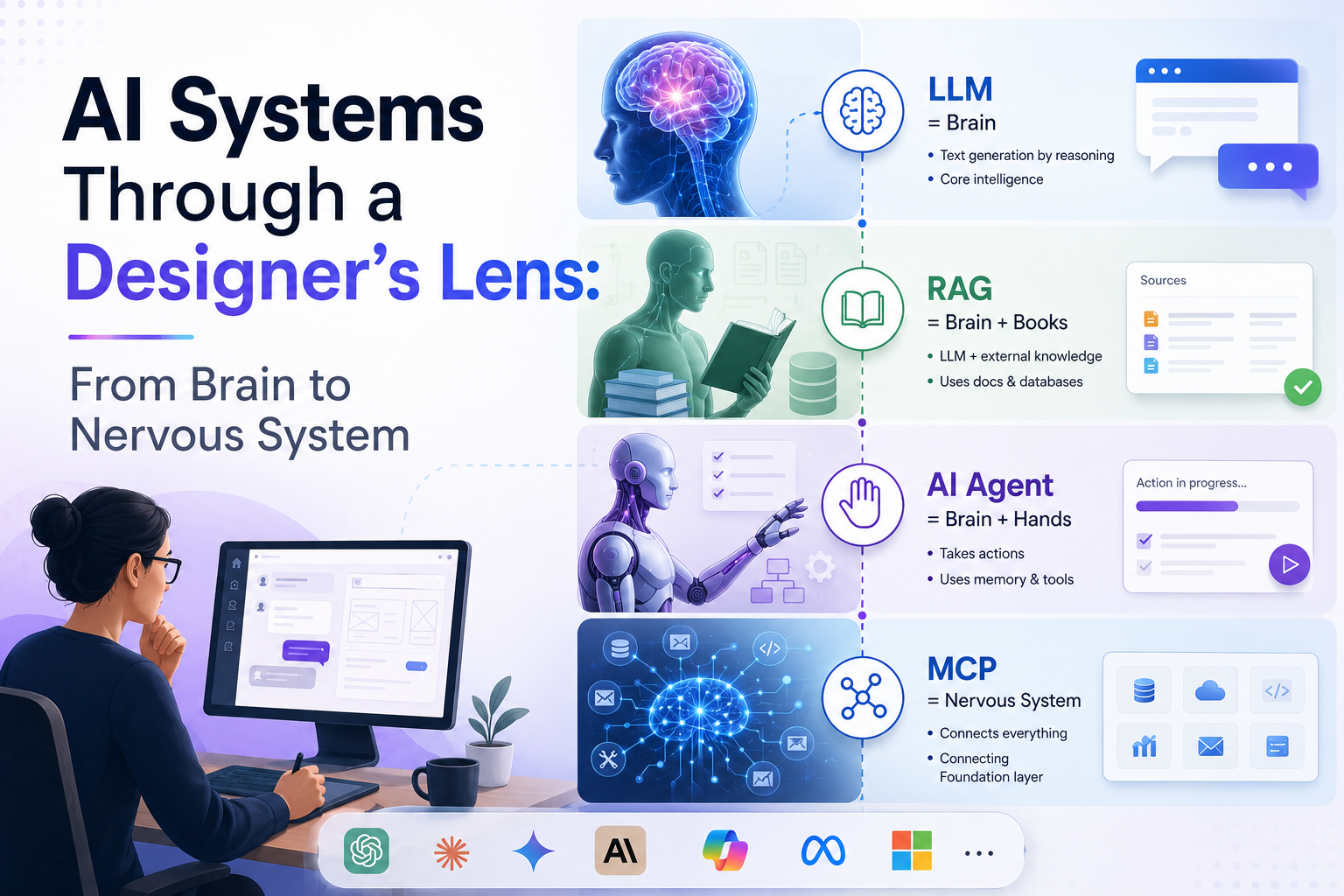
AI Systems Through a Designer’s Lens: From Brain to Nervous System
AI is becoming a bigger part of the product designer’s toolkit—but understanding what sits behind the interface is becoming just as important as designing the interface itself.
A useful way to understand modern AI systems is to think of them like the human body.
For designers, this analogy is especially powerful because it shifts the conversation from “Which AI tool should I use?” to “What role does AI play in the experience I’m designing?”
1. LLM = The Brain
An LLM is like the brain of an AI system.
It provides reasoning, language generation, interpretation, and the ability to respond to a user’s input.
From a design perspective, this means we can move beyond traditional interfaces where users simply:
Click → Select → Submit → Wait
With LLMs, interfaces can become more conversational and adaptive:
Ask → Explain → Refine → Generate
What this means for designers
Designers need to start thinking about:
- How users express intent
- How the system interprets ambiguous requests
- How AI communicates uncertainty
- How users correct AI
- How much control the user should retain
- How the interface explains why something happened
The challenge isn’t simply designing a chat interface.
It’s designing interaction around intelligence.
2. RAG = Brain + Books
An LLM by itself doesn’t necessarily know your company’s latest information, internal processes, product documentation, or customer data.
That’s where RAG (Retrieval-Augmented Generation) becomes useful.
Think:
Brain + Books
The AI can retrieve relevant information from documents, databases, knowledge bases, or other sources before generating its response.
For designers, this introduces an important UX problem:
Where did this answer come from?
Traditional interfaces usually show a source through a link.
AI experiences can go further.
Designers can create:
- Source citations
- Document previews
- “Used these sources” sections
- Confidence indicators
- Knowledge freshness indicators
- Expandable evidence
- Clear distinction between retrieved information and AI-generated interpretation
This creates a new design principle:
Don’t just design the answer. Design the user’s ability to trust the answer.
3. AI Agent = Brain + Hands
This is where things become really interesting for product designers.
An AI Agent doesn’t just generate an answer.
It can take action.
Think:
Brain + Hands
An agent might:
- Search information
- Create a ticket
- Update a database
- Send an email
- Generate a report
- Trigger a workflow
- Call APIs
- Use other software tools
This fundamentally changes the interaction model.
Instead of:
User → Interface → Action
We start moving toward:
User → Intent → AI → Actions → Outcome
The designer’s role changes
We are no longer only designing screens.
We are designing:
Intent → Planning → Execution → Feedback → Recovery
That means agentic UX needs things like:
- Action previews
- Approval steps
- Progress visibility
- Undo / rollback
- Permission controls
- Error recovery
- Human escalation
- Audit trails
The key question becomes:
How much autonomy should we give the AI?
Not every action should be fully autonomous.
4. MCP = The Nervous System
If the agent is the hands, something needs to connect those hands to the rest of the digital environment.
This is where MCP (Model Context Protocol) can be thought of as the nervous system.
It helps AI systems connect models and agents with tools, data, and external capabilities in a structured way.
For designers, this is important because it enables AI experiences to move beyond isolated chatbots.
Imagine a design assistant that can understand:
Your product requirements + design system + user research + analytics + codebase + project management tools
Now AI isn’t operating in a vacuum.
It becomes part of the product ecosystem.
What Does This Mean for Product Designers?
The biggest shift isn’t that AI will replace the UI.
It’s that the UI itself is changing.
For years, designers primarily designed:
Screens + Components + Navigation + Workflows
With AI, we’re increasingly designing:
Intent + Context + Intelligence + Actions + Trust
That requires a different mindset.
1. Design for intent, not just interaction
Instead of asking:
“What button should the user click?”
Ask:
“What is the user actually trying to accomplish?”
AI can potentially take care of multiple intermediate steps.
2. Design the AI’s boundaries
An AI system should not feel like it can do everything.
Users need to understand:
- What AI can do
- What AI cannot do
- What AI is currently doing
- What requires approval
- What happens if something goes wrong
Good AI UX makes these boundaries visible.
3. Design for uncertainty
AI can be confident and still be wrong.
Therefore, confidence, sources, assumptions, and uncertainty become UX elements.
This is one of the biggest differences between traditional software and AI-powered products.
4. Design for collaboration between human and AI
The best AI experiences aren’t necessarily:
AI does everything.
They’re often:
Human decides → AI assists → Human reviews → AI executes
The designer’s job is to find the right balance between automation and control.
The Bigger Design Opportunity
The evolution looks something like this:
LLM
→ AI can think and generate
RAG
→ AI can access relevant knowledge
Agent
→ AI can take action
MCP / Connected Systems
→ AI can interact with an ecosystem
And this creates a completely new design space.
We are moving from designing interfaces people operate to designing systems people collaborate with.
That is a significant shift for UX.
The future product designer won’t just need to understand typography, grids, components, and interaction patterns.
They’ll also need to understand:
AI behavior + context + tools + autonomy + trust + human oversight.
Because when AI becomes part of the product, designing the interface is only one part of designing the experience.
The real question isn’t “Will AI change design?”
It already has.
The more interesting question is:
Are we designing AI as a feature—or designing products around AI as a new interaction model?
I’d love to hear how other designers are approaching this shift. Share your thoughts and experiences in the comments below.